

September 2024 Market Update
The S&P 500 started the month of August on a sour note, with its largest one-day decline (Monday, August 5th) since the fall of 2022. However, the pullback was short-lived, and the S&P 500 finished the month in the green. Below are the August returns for the popular benchmarks that investors track (Data provided by Y-Charts & Commonwealth Financial Network):
S&P 500 Index: +2.28%
Dow Jones Industrial Average: +1.76%
Nasdaq Composite Index: +0.65%
Russell 2000 Index: +1.75%
S&P Target Moderate Risk Index: +1.78%
More likely than not, the Federal Reserve will cut interest rates at their next meeting this month (9/18). As of September 1st, there was a 70% chance that rates will be lowered by 0.25% and a 30% chance that rates will be cut by 0.5%. We believe the sell-off in late July or early August was attributed to the following information:
- Unemployment rate at the highest level since October 2021 (Stockcharts.com)
- Jobless claims at the highest level since November 2021 (Source: Trading Economics)
- Unwind of the Japanese Yen carry trade https://youtu.be/0tUl0t93TI0
- Inflation at multi-year lows and the Fed NOT cutting interest rates at their July meeting
Below is a chart that shows the performance of small, mid, and large-cap stocks after the Fed’s first rate cut since 1954. As you can see, small-cap stocks tend to benefit the most after the first rate cut across 3, 6, and 12-month time periods. This chart shows that stocks still have room to run to the upside when interest rates are falling.
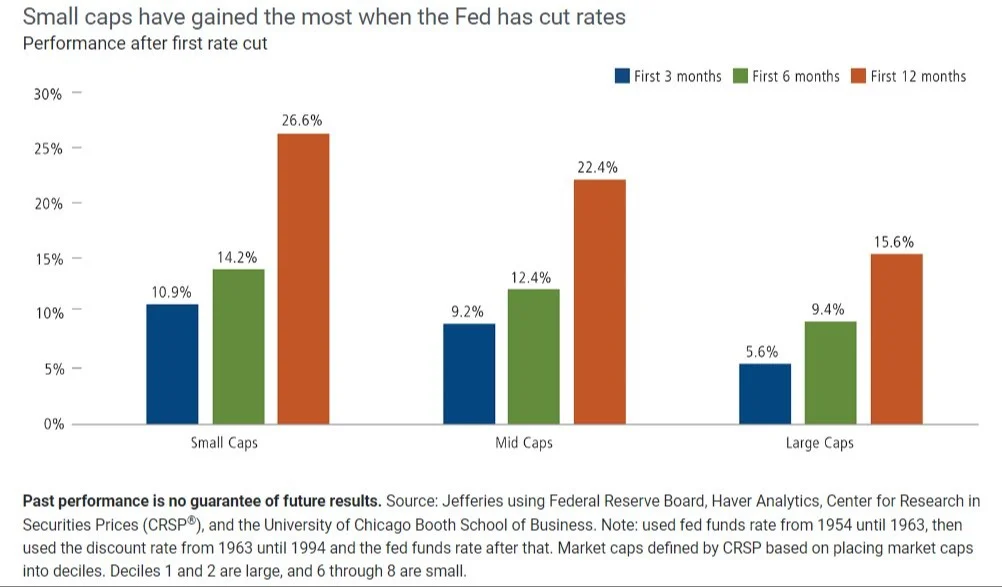
However, since 2000, stocks have struggled after the Fed’s first rate cut. Below is a chart of the S&P 500 in blue with the Effective Federal Funds Rate in gold. The Fed will have its hands full trying to navigate lower interest rates without slowing down the economy or stock market.

As a reminder, September and October have been historically weak for stocks, especially during an election year. Below is seasonal data from Stockcharts.com that shows this weakness:
- In the past 10 years, the S&P 500 has closed lower in September 67% of the time with an average return of -2.4%
- During the past 4 election years, the S&P 500 has closed lower in September 75% of the time with an average return of -2.7%, and October has closed lower all 4 years with an average return of -5.9%
The silver lining, though, is that election years tend to be overwhelmingly positive in the final 2 months of the year. November has been positive in 3 of the last 4 election years, and December has been positive in 4 out of 4 previous election years.
Our outlook has not changed as we believe stocks will experience some volatility over the coming weeks and months. After the election, when we know who the next president is, we are still in the camp that stocks will benefit from a “relief-rally” to end the year.
As always, don’t hesitate to reach out to our team with any questions you may have.

Forward-looking statements are not guarantees of future performance and involve certain risks and uncertainties, which are difficult to predict. Past performance is not indicative of future results.