

May 2026 Market Update
After one of the weakest months we’ve seen in the past year (March), stocks rebounded sharply in April, regardless of where you looked. In fact, it was one of the quickest V-shaped recoveries on record. Below are the April returns for the popular benchmarks that investors track (Data provided by Y-Charts & Commonwealth Financial Network):After one of the weakest months we’ve seen in the past year (March), stocks rebounded sharply in April, regardless of where you looked. In fact, it was one of the quickest V-shaped recoveries on record. Below are the April returns for the popular benchmarks that investors track (Data provided by Y-Charts & Commonwealth Financial Network):After one of the weakest months we’ve seen in the past year (March), stocks rebounded sharply in April, regardless of where you looked. In fact, it was one of the quickest V-shaped recoveries on record. Below are the April returns for the popular benchmarks that investors track (Data provided by Y-Charts & Commonwealth Financial Network):
- S&P 500 Index:+9.64%
- Dow Jones Industrial Average: +6.63%
- Nasdaq Composite Index: +13.97%
- Russell 2000 Index: +11.44%
- S&P Target Risk Moderate: +3.97%
Markets appeared to look past geopolitical concerns during the month and instead focused on the next 6–12 months. Earnings season began in the first half of April, and overall, results from many of the world’s largest companies were better received than expected.
Historically, strong Aprils like this have been meaningful. There have only been a handful of instances where the S&P 500 gained more than 5% in April, and forward returns for the remainder of the year have typically been strong following those periods.
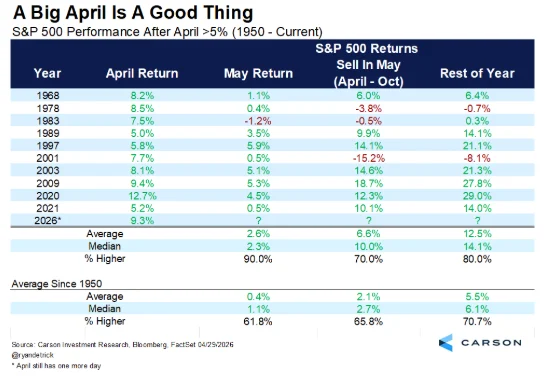
You’ve likely heard the phrase “Sell in May and go away,” which suggests markets tend to struggle from May through October. However, recent data tells a different story. The S&P 500 has been positive in 12 of the past 13 Mays, 9 of the past 10 Junes, and every July over the past 11 years. Not exactly the type of consistent weakness that the phrase implies.
That said, we continue to monitor the broader backdrop carefully. As we’ve discussed in recent months, this is a midterm election year, a period that has historically seen increased volatility and weaker performance during the second and third quarters. It’s possible that some of the typical mid-year weakness was pulled forward into March amid geopolitical tensions. However, that’s something we’ll only be able to confirm with the benefit of time.
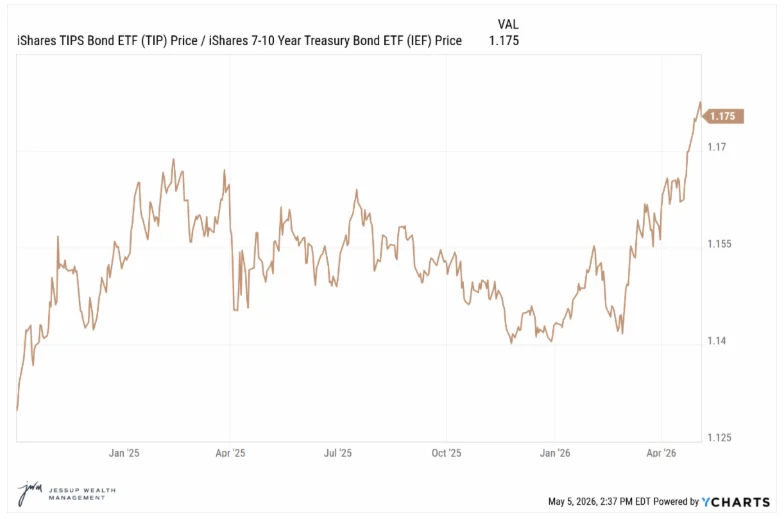
One area we are watching closely is inflation expectations. A useful way to track this is by comparing Treasury Inflation-Protected Securities (TIPS) to traditional U.S. Treasury bonds. TIPS are designed to adjust with inflation as their principal value rises as inflation increases and falls as inflation declines.
In the chart referenced below, we compare the iShares TIPS Bond ETF to the iShares 7–10 Year Treasury Bond ETF. When this ratio trends higher, as it is currently, it suggests that inflation expectations are rising. In other words, the market is beginning to price in greater inflation risk.
What stands out is that inflation expectations have continued to move higher even as the Federal Reserve has been cutting interest rates since the fall of 2024. That’s a dynamic we’re monitoring closely, as it could influence both bond and equity markets going forward.

Forward-looking statements are not guarantees of future performance and involve certain risks and uncertainties, which are difficult to predict. Past performance is not indicative of future results.