

June 2025 Market Update
Stocks posted solid gains across the board in May, continuing their recovery from the initial tariff announcements made in early April. Below are the May returns for the popular benchmarks that investors track (Data provided by Y-Charts & Commonwealth Financial Network):
S&P 500 Index: +5.49%
Dow Jones Industrial Average: +3.72%
Nasdaq Composite Index: +7.92%
Russell 2000 Index: +4.58%
S&P Target Risk Moderate: +2.08%
Just over a month after one of the most volatile periods in market history, the relatively quiet month of May was a welcome change. The VIX, or Volatility Index, is like a fear gauge for the stock market. It measures how much investors think the stock market (specifically the S&P 500) will move up or down in the next 30 days.
Generally, a low VIX reading suggests investors expect smaller market moves and relative stability, while a high VIX signals that investors are bracing for larger swings. Think of it like a weather forecast — but instead of predicting rain or sunshine, it predicts how stormy the stock market might be.
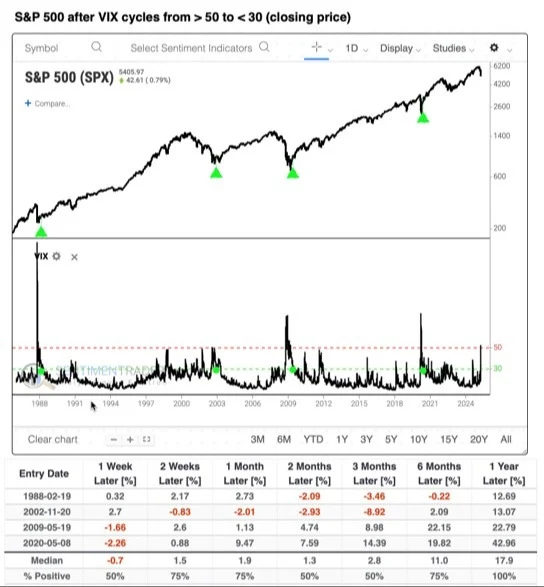
Earlier this year, on April 7th, the VIX closed above 50 — an exceptionally high level that reflected intense market fear. Remarkably, within just 10 days, by April 17th, the VIX had fallen back below 30, signaling a rapid shift toward calmer market expectations.
The chart below highlights previous instances when the VIX dropped from such elevated levels to more moderate ones. Historically, when fear subsides this quickly, S&P 500 returns over the following year have tended to be strong (though it’s important to note that the sample size is small, and past performance does not guarantee future results). As you can see, this tends to occur near major market bottoms.
Now, does this mean stocks will move steadily higher for the rest of the year? Of course not. As we discussed at the start of the year, we continue to expect 2025 to be marked by heightened volatility. A market pullback before the fall would not be surprising.
Below is a chart we’ve shared previously, which illustrates the average S&P 500 performance (blue line) during post-election years dating back to 1950. Historically, it’s been common to see periods of weakness in late summer and early fall, making any short-term selling during that time a normal part of a typical market cycle.

Again, our outlook for 2025 has not changed. We remain cautiously optimistic about the rest of the year, and it would be an additional bonus if some new, finalized trade deals start to pop up over the next few months.
As always, don’t hesitate to contact our team with any questions.

Forward-looking statements are not guarantees of future performance and involve certain risks and uncertainties, which are difficult to predict. Past performance is not indicative of future results.