

February 2025 Market Update
Stocks kicked off the new year with gains, a historically positive signal for market performance in the months ahead.Below are the January returns for the popular benchmarks that investors track (Data provided by Y-Charts & Commonwealth Financial Network):
S&P 500 Index: +2.7%
Dow Jones Industrial Average: +4.7%
Nasdaq Composite Index: +1.64%
Russell 2000 Index: +2.58%
S&P Target Risk Moderate: +1.56%
As I mentioned above, a strong January has been a reliable indicator of positive full-year market performance. I want to highlight two key metrics that consistently provide valuable insights into how the rest of the year may unfold.
First Five Days of January Indicator
Since 1950, when the first five trading days of January are positive for the S&P 500 (+0.6% this year), stocks finish the year higher 83% of the time with an average gain of +14.2% (Source: Stock Trader’s Almanac).
January Barometer
The saying is, “as the S&P 500 goes in January, so goes the year”. Since 1950, when the S&P 500 posts a positive return in January, the market has ended the year higher about 88% of the time, with an average annual gain of +17%. (Source: Stock Trader’s Almanac) .
We like to say that “history never repeats, but often rhymes,” and the data from these two key metrics should give the bulls reason for optimism. That said, positive stock returns are never guaranteed, and there have been years when the S&P 500 ended in the red. However, understanding historical trends can provide valuable perspectives as we navigate the path ahead and make informed investment decisions.
February Returns during Post-Election Years
Looking ahead to the rest of February, the second month of the year has not been kind to investors the year after an election. In fact, February has historically been the weakest month for stocks in post-election years. Given this pattern, some market volatility in the coming weeks wouldn’t be unexpected.

Tariff News
We’ve already seen a wave of tariff-related headlines in the media this month, and it’s likely just the beginning. During President Trump’s first term, tariffs were a frequent topic of discussion and policy action. While there were periods of market sell-offs and corrections between 2016 and 2020, the broader stock market still delivered strong performance during his first term in office.
I mention this not to spark a political debate but to reinforce the importance of staying focused on the long term rather than getting caught up in day-to-day media narratives. The media’s primary goal is to capture attention, and sensational headlines drive views and clicks. However, reacting emotionally to these headlines can derail the disciplined investment strategy we’ve carefully built. Staying committed to the long-term plan remains the key to financial success.
Super Bowl
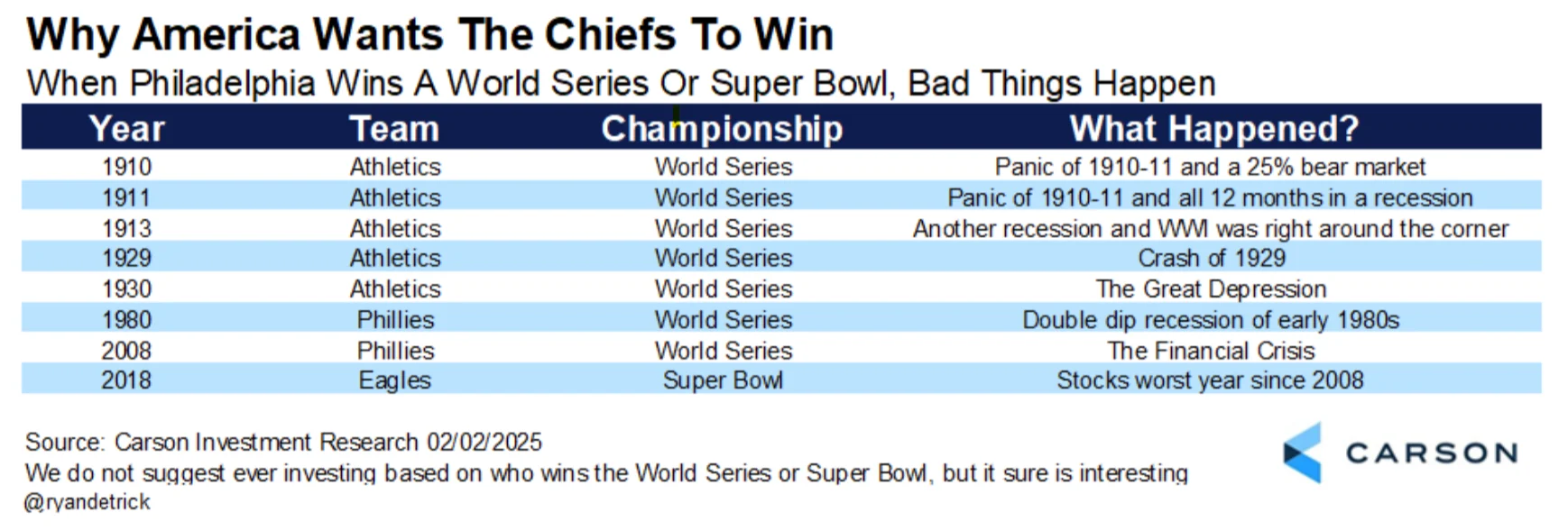
To end on a fun note, here’s a question for you: Who does the stock market want to win the Super Bowl?
In my (unbiased!) opinion, we should be cheering for Kansas City—not just for a win this year, but for a historic “three-peat.” Why? Our friend Ryan Detrick dug into the data, and history suggests that the stock market doesn’t fare too well when Philadelphia sports teams take home championships. Of course, I was hoping my Washington Commanders would make a surprise run to the big game this year—but hey, there’s always next season!
As always, don’t hesitate to contact our team with any questions.

Forward-looking statements are not guarantees of future performance and involve certain risks and uncertainties, which are difficult to predict. Past performance is not indicative of future results.