

July 2026 Market Update
|
The first half of 2026 is officially in the books. While June proved a bit bumpy for equities, Q2 2026 still ranks among the strongest second quarters we’ve seen on record. Below are the June returns for the popular benchmarks that investors track (Data provided by Y-Charts & Commonwealth Financial Network):
|
After a rocky start to the year, stocks more than made up for it in the second quarter. As geopolitical headlines faded, investors turned their attention back to what truly drives long-term stock appreciation: corporate earnings.
History offers an encouraging signal here. When the S&P 500 gains more than 10% in the second quarter, as it did this year, the months that follow have tended to be strong. The chart below from Ryan Detrick shows Q3 and Q4 returns following a powerful second quarter. Under this rule set, the final six months of the year have been negative only once, with an average return of 11.7%.
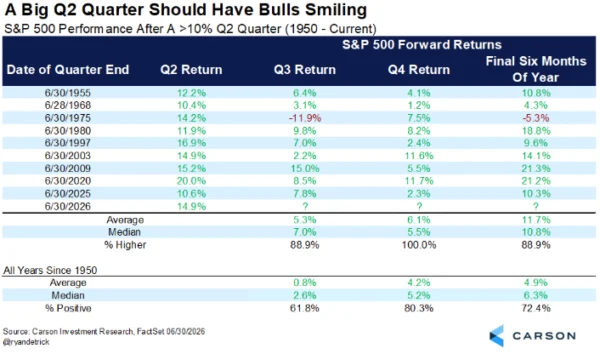
This is especially notable in a midterm election year. As we’ve discussed throughout 2026, Q2 of a midterm year has historically been the weakest quarter of the entire four-year presidential cycle. The S&P 500 posting double-digit gains during a seasonally soft period is worth paying attention to. When an asset class outperforms its historical average to the upside, it can signal a stronger environment than many investors expect.
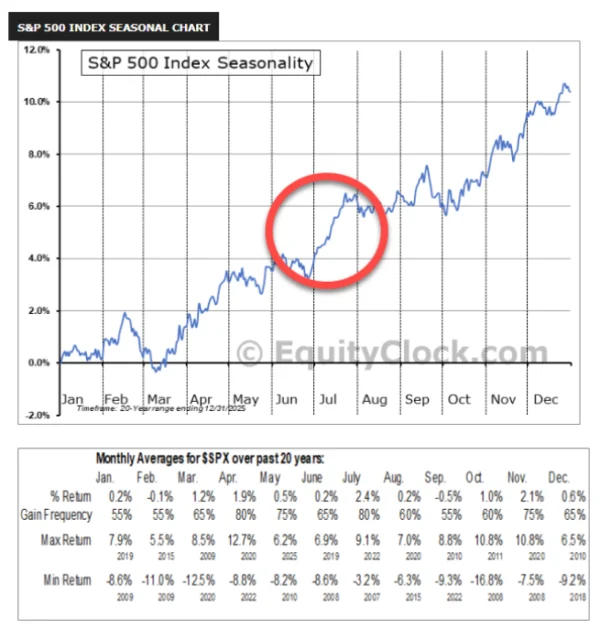
Looking ahead, July has typically been kind to stocks. Over the past 20 years, the S&P 500 has finished the month positive 80% of the time, with an average gain of 2.4% (source: EquityClock.com). And a look at the S&P 500’s seasonality chart shows that the first half of July tends to deliver the bulk of those gains.
|
|
|

Forward-looking statements are not guarantees of future performance and involve certain risks and uncertainties, which are difficult to predict. Past performance is not indicative of future results.